
The Cartoon on the Bottle: How Producers and Importers Build an American Brand, and Who Ends Up Owning It

Abstract
In August 2026, Gibson & Jeffery Law interviewed Monica Samuels, the President of Komé Collective, one of the most notable sake importers in the United States. In this article, Rik D. Jeffery, Esq. argues that every alcoholic beverage category carries a negative cultural inheritance in its home market, and that sake’s opportunity in America rests on having arrived here without one. Localization is the work of deciding what a product is allowed to mean in a new market, and it is work a producer and an importer do together. The American identity that comes out of localization is itself a collection of assets that can belong to either party, and whose ownership is more often settled on purpose by one side and accepted by default by the other. In the context of importer-producer relationships, this reality makes the choice of partner, and the terms the partnership starts on, more consequential than either party may expect.
Introduction
Recently I had the opportunity to sit down with Ms. Monica Samuels, the President of Komé Collective.1 Komé Collective brings Shiokawa Brewery’s products into America, and it was Shiokawa-sensei who made the introduction after I published “The American Market Ecology of Japanese Sake,” the article about the month I spent in Japan in 2025. Her knowledge of sake and her evident passion for the industry and the people in it left a mark, and it has taken me a few weeks to work out what the lessons of our conversation actually are.
In “The American Market Ecology of Japanese Sake,” I argued that continued growth in the US sake market will not happen through mass market distribution, and that it will instead be driven by targeted cultural integration supported by education, improved localization, and on-site consumption venues. Nothing Ms. Samuels told me has moved me off that argument, though she added nuances to it that I had not anticipated. What I came away with is a more concrete understanding of what cultural integration actually means in practice: it is work a producer and an importer do together, it builds an American identity for the product that has real commercial value, and the question of who owns that identity gets settled by default far more often than on purpose.2
Some context about Ms. Samuels and Komé Collective is necessary before any of that will make sense. Ms. Samuels grew up bilingual and bicultural with a grandfather who brewed sake.3 She spent more than fifteen years working the restaurant, distributor, and importer sides of the business, and was named a Sake Samurai in 2017.4 I suspect that bicultural background does a great deal of the work in how she operates Komé Collective. Komé Collective sits inside Vine Connections, the importing company that Nick Ramkowsky founded in 1999, originally to reintroduce Argentinean wine to an American audience. Its sake portfolio began when John Gauntner (arguably now the leading non-Japanese authority on sake) was put in touch with Ramkowsky while looking for a way to get sake to friends in America at a larger scale than the free space in his suitcase. Ms. Samuels has been a student of Gauntner’s since 2008, and she now curates the Komé Collective portfolio alongside him. In 2020 the company sold more sake than wine for the first time and stopped describing itself as the sake arm of a wine importer.5
Every Category Has a Bad Family Memory
I think one of the most important lessons about cultural integration that I took from my conversation with Ms. Samuels is that it requires putting forward a positive cultural identity for a product, and that it also requires countering whatever negative cultural baggage the product already carries. As I mentioned, Komé Collective is part of a wine importer, so this lesson came up in the course of our conversation about what sake and wine might learn from each other.
Ms. Samuels offered an image for wine’s problem in America: a generation that came home from school to find their mother already half a bottle of chardonnay in, with the whole bottle gone by dinner. Sake’s problem in Japan has much the same shape: a great many Japanese drinkers grew up with a father or a grandfather who had too much sake and ended up talking to strangers in the street. What this means is that wine carries a negative cultural inheritance in America that sake simply does not, and that reciprocally, sake carries one in Japan that wine simply does not.
Do the Numbers Support the Story?
Arguably this cultural narrative has some backing in the economic numbers. In an environment where Americans are drinking less of nearly everything,6 American imports of Japanese sake have grown over the last five years.7 Similarly, in an environment where the Japanese are drinking less too, what sets sake apart is that its decline started earlier and has gone further than the rest.8 Wine has suffered no such fate in sake’s home market. Japan has been one of Asia’s first or second largest wine importers for decades.9
More tellingly, the areas of alcoholic beverage consumption that have seen continued growth in America are the categories that have distinguished themselves from mom’s chardonnay, such as natural wine and the ready-to-drink beverages.10 Unlike mom’s chardonnay, these categories do not rely on the old-world aristocratic sophistication and luxury that is plastered all over so much of the wine aisle. Something similar has happened in Japan, where the categories that have gained ground are cheap and unceremonious drinks that carry none of sake’s trappings and none of its upper-class kanji calligraphy, and which are not sake at all.11
So What Are the Rules?
I think that what these numbers and this cultural narrative point to are some general rules.
- Identify the Product’s Cultural Inheritance:
- If there is no strong inheritance associated with your product that is a good thing to know, because then you know you are building the message from scratch. For instance, when compared to wine, sake is something of a rounding error in what Americans currently drink12, and that is an opportunity that Ms. Samuels and many others in this industry are taking advantage of.
- Where there are positive inheritances, build on them, take advantage of them, and expand them.
- Where there are negative inheritances, know them and avoid the markers of the negative cultural inheritance that your target consumer might associate with your product.
- Consider pivoting in the opposite direction on negative cultural inheritances.
- Where negatives are associated with an older product that moves toward ceremony and aristocratic sophistication, the newer version does not take itself too seriously, even if it is a luxury item. The newer product speaks to fun and joy in today’s world, even while it recognizes its own cultural history and context.
- Business fundamentals are still king.
- These rules are about market messaging. Messaging is vital to running a successful business. But messaging is just one part of competently running a business, and it is not a substitute for making a high-quality product for the target consumer.
- Ms. Samuels shared with me that she often wants to see a sake brand’s domestic success before considering exporting because it demonstrates that the underlying business is strong enough to support the extra demand and challenges that come with export.
A Bottle That Does All of This at Once
I think a good example of these principles is Komé Collective’s Yamada “Everlasting Roots,” Tokubetsu Junmai, pictured below. I admit that in preparation for our interview I tasted quite a few Komé Collective sakes. It was a lot of fun. During my conversation with Ms. Samuels I brought this one up as one of my favorites, both because of how tasty it was and because of how engaging I found the trade dress13.
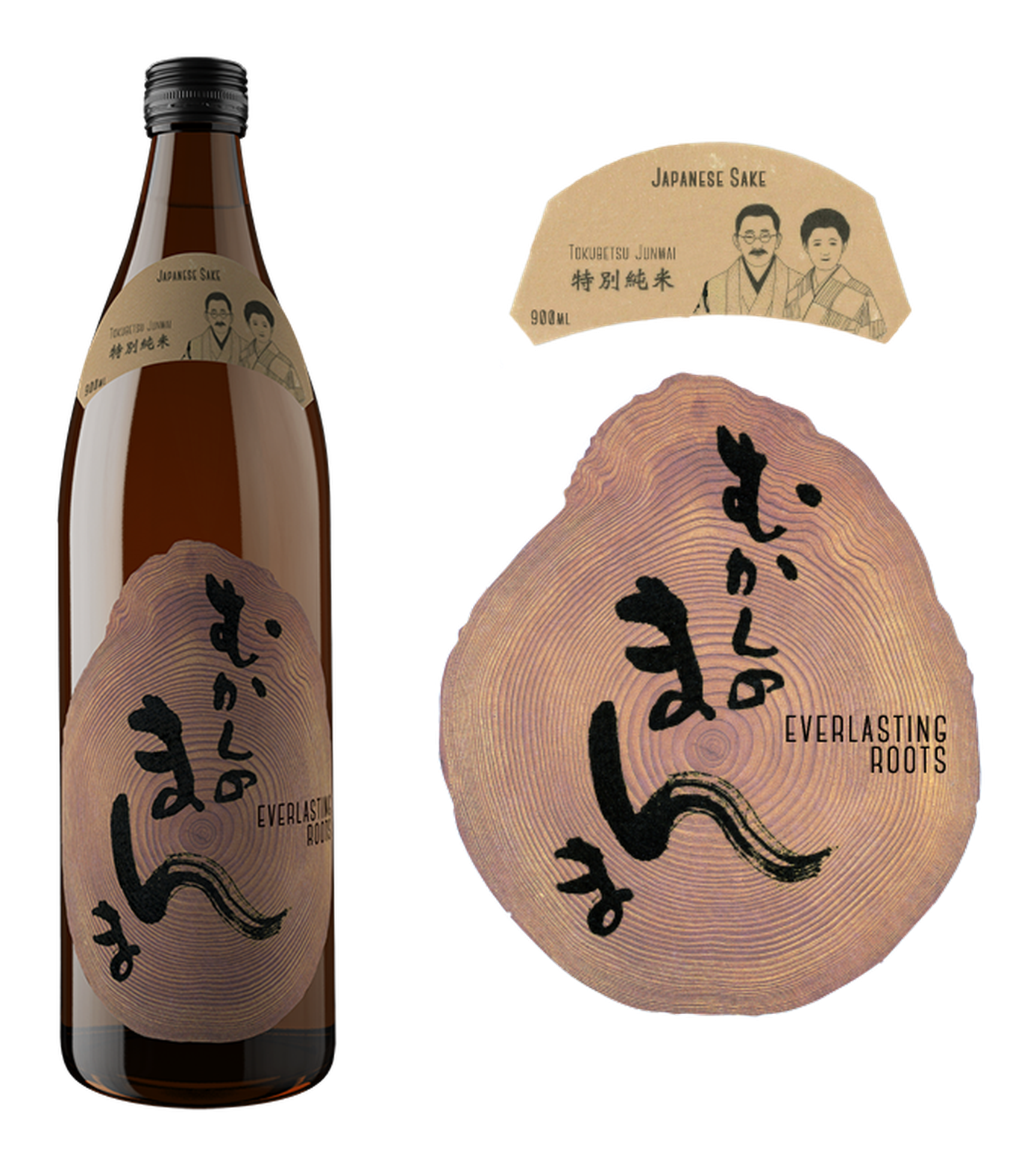
The label translates to “nothing has changed since the beginning.” While that may be true of the liquid inside, it is not true of the product’s trade dress or its market statement. I think the labeling represents a pivot. The idea of everlasting roots might speak to old-world sophistication, but at least to my eye there is a charming informality to the Japanese calligraphy on the bottle, which is set over an irregularly shaped wood print background. At the top of all of this is an adorable caricature of an older Japanese country couple. I felt like I knew who these people were, and Ms. Samuels explained that the drawings were essentially cartoon caricatures of the typical Japanese country grandparents.
Note the application of the rules here. This product has all the history and context needed to make the trade dress a kanji filled ceremonial old-world mess, and the brewery made it casual instead. Note too that the name is written in hiragana rather than kanji, which is the softer and more everyday of the two scripts14. The brewery had every reason to reach for ceremony and chose not to. Where the sake’s own style and history could just as easily have summoned the grandfather who drinks too much, these caricatures are adorable and fun. They remind me at least of the older Japanese folks I know (like my own ninety-one year old grandmother) who despite being stuck in her ways knows how to have a good time.
While the bottle and the market statement identify a negative inheritance and use the trade dress to pivot away from it, there is no question that the liquid inside the bottle is impeccable traditionally brewed sake. This sake is made by Yamada Shoten Brewery, founded in 1868. It is one of Komé’s smallest breweries, it mills its own rice in-house, which is unheard of at that scale, and it brews at ambient temperature with no heating or cooling control.15 In other words, the underlying liquid is excellent, very traditional, and it comes from a business that has been consistently making traditional sake for more than 150 years.
Is a Cartoon Even Allowed on a Bottle?
I mentioned the cartoon caricatures on Everlasting Roots, because I think it is one of the most powerful design elements on the bottle. I think it is a strong example of how a good importer like Komé Collective can add localization value that would be very hard for a foreign producer to achieve on their own, even though the cartoon itself was not Komé Collective’s idea.
In America, a cartoon on an alcohol label is not a free or easy choice. The federal labeling rules cover pictures as directly as words: a label may not carry any “statement, design, device, or representation which is obscene or indecent,” and the same vocabulary runs through the rest of the prohibited practices.16 In practice this means an image is not decoration sitting outside the regulated part of the label. It has to survive the same scrutiny a sentence would.
Moreover, almost every alcoholic beverage label needs approval from the federal government before the bottle can be sold. For wine, sake included, that means a certificate of label approval from the TTB17 is required before the bottle can leave the brewery or customs, unless it will never cross a state line. A label with an image that a TTB specialist reads as misleading or as indecent is a label that does not get a COLA.18 Put another way, an image that reaches an audience the product should not be reaching may not get a COLA.19 In my own practice I have seen the Bureau reject artwork on exactly that basis.
California adds a prohibition of its own on the advertising side. Business and Professions Code section 25664 makes it unlawful to use in any advertisement of alcoholic beverages any “subject matter, language, or slogan addressed to and intended to encourage minors to drink the alcoholic beverages,” while expressly preserving advertising directed at persons of legal drinking age.20 It is a prohibition that turns on intent.
The industry draws the line more sharply than either government does. For instance, the Wine Institute’s Code of Advertising Standards prohibits “cartoon characters” along with any “depictions, images, figures, or objects that are popular predominantly with children,” naming Santa Claus and the Easter Bunny as examples of what it has in mind. Their Code reaches product labels and packaging and not merely advertising, and it requires Wine Institute members to comply. Not every importer is a member, so the Code works as an industry norm rather than as a universal rule.21 The test here is not whether a label carries a drawing, it is whether the drawing is one that children are drawn to.
Fortunately, an affectionate caricature of two elderly farmers sits comfortably on the right side of all of these lines in a way that a cartoon animal, or a cheerful child, might not. Nonetheless, whether that caricature would clear a COLA and sit comfortably with American buyers was a risk that Komé Collective was in a better position to weigh than the brewery was. Moreover, compliance professionals within Komé Collective were no doubt better able than a foreign brewer to have conversations with American regulators about their concerns over the label as necessary approvals were collected prior to importation.
Whose Idea Was the Pivot?
Yamada Shoten designed this label themselves, for their own domestic market, where the sake is sold as むかしのまんま22. Komé Collective brought it over essentially as it was. What the importer added was not the drawing but the judgment that the label would both work, messaging-wise, in the American market and pass regulatory scrutiny here. This is a different kind of localization value and not a smaller one.23 Knowing when a product’s identity needs to be updated for a new market is just as important as knowing when what it already is will be effective in a new space. Good importers like Komé Collective exist in large part because they are positioned to exercise this sort of judgment. This is a judgment that Komé Collective stands by, as it regularly buys out Yamada Shoten’s entire production.24
Compare Shiokawa Brewery’s Cowboy Yamahai, which I wrote about in my first article. That bottle also trades calligraphy for an image an American can read instantly, but the impulse came from Niigata. Shiokawa-sensei personally resonated with two ideas: the notion—held by Beau Timken of True Sake—that Shiokawa’s Yamahai sake pairs exceptionally well with steak, and the image of the "pioneering cowboy" representing sake’s venture into the new market of steakhouses. It was Beau Timken who named the sake based on these two concepts25 The pivot there was the brewer’s own, and an American helped him land it.
Shiokawa’s のぱ26 sits somewhere in between. The inspiration was his, drawn from meals he ate at San Francisco’s NoPa Restaurant, while the Japanese label was remade for the American market by Komé Collective.27 Note what these three have in common. In every one of them the impulse came from Japan, and what changed at the water’s edge was how much of the execution happened here. Localization exists on a spectrum, the idea and the execution can each sit on either side of the ocean in any combination, and the bottle on the shelf will not tell you which.
Good localization frequently looks exactly like this. It is a collaboration. Ms. Samuels told me that she adds brands to Komé Collective’s portfolio very carefully, one at a time, and that she will often work with a producer for years before launching anything in America. That time is crucial. Identifying the right product and doing the work to bring it here is slow, and building the trust between a producer and an importer that the work depends on is slower still.
A small brewery with no marketing department and no particular feeling for what an American consumer finds charming is far better served by an importer who does than by a faithful translation of its domestic packaging, even though there are times when that will turn out to be the right choice. Unfortunately, the thing that makes this arrangement work is also the thing that makes it worth pausing over. A producer often gives up a lot of economic leverage and content control when they let somebody else decide what their bottle looks like when it crosses the Pacific. This all raises a question that may not get asked often enough at the moment it matters: who owns the American identity of a brand once someone else has built it?
Who Owns a Sake’s American Image?
Given the complexities of American law, there are two answers here. The first answer is that it belongs to whoever the parties have agreed it belongs to. Courts have ruled that as between a foreign manufacturer and its exclusive American distributor, the law presumes that the manufacturer owns the trademark, unless there is an agreement to the contrary.28 In practice this means that a producer who signs nothing starts out nominally owning the trademark and the trade dress, and that a single clause in an agreement can give the importer ownership of both before anyone has sold a bottle. This is not necessarily a bad thing, but it is important to be aware of, and a good reason to be sure that you really trust your importer.
It is worth being precise about how these contract terms actually get drafted, because a good lawyer’s job is to make sure that every term in the document is an intentional choice. This means that what looks like boilerplate is rarely boilerplate for both sides at once. A clause assigning the American trademark to the importer is not an accident. What makes it feel like boilerplate is that the other side did not read it as a decision, or did not know there was a decision to be made. It runs in both directions. A producer with good counsel at home can be just as deliberate about a term the importer signs without pausing. Neither of those is adversarial in itself. It is simply what happens when one party has thought about a question and the other has not.
The second answer is the practical one, and it is less comfortable. What we have been loosely calling the image is not one asset. It is at least three, and they do not travel together. Two of them are creatures of trademark law: the mark, which is usually the name on the bottle, and the trade dress, which is the overall look and feel of the package and can reach as far as the shape of the bottle.29 Analyzed together, those two are what we ordinarily mean when we say a brand. Analyzed separately, each is an asset in its own right, and each is subject to the ownership test on its own. The third, the label artwork itself, is largely governed by copyright law. Finally, America’s COLA system functions as a regulatory overlay that can hand the holder of the certificate practical control over the product’s route to market, whoever owns the mark.
The ownership test for a trademark starts with a presumption. As noted above, courts assume a manufacturer owns the trademark unless there is an agreement to the contrary. But this presumption is rebuttable, and the factors a court weighs read almost like a description of what a good importer does for a living: (1) which party invented the mark and first put it on the product, (2) whose name appeared alongside it, (3) which party kept the quality consistent, (4) which party the public identifies the product with and complains to when something goes wrong, and (5) which party holds the goodwill.30 So under American law an importer who built the American identity can make a real argument on most of those, even if there isn’t already a clause in the importation agreement that settles the issue.
Who Owns the Drawing?
The third asset is not a trademark question at all. The artwork on the label may be a copyrighted work, and copyright is a different statute answering a different question, with its own rule about who owns a work and its own rule about how that ownership moves. If the importer’s own employees drew the image or created the other original design elements on the bottle as part of their jobs, the importer owns the copyright in it. If the importer or producer commissioned an outside illustrator and never took a written assignment, then the illustrator owns it, and neither the brewery nor the importer does.31 A work-for-hire clause will not usually rescue them, because for a commissioned work, work-for-hire ownership operates only within nine statutory categories and label art does not fit any of them.32 An agreement can call the drawing a work made for hire in perfectly clear language and still leave the copyright exactly where it started.
While a sophisticated importer will know to take a written assignment, a small-time producer sourcing their own design work may very well not know to ask for one, or may rely on a work-for-hire clause that does not do the job. This can produce one of the worst conversations, because the asset everybody is fighting over ends up belonging to a freelancer who was paid a few hundred dollars god knows how many years ago. That said, usually the producer or the importer is not left unable to use the picture, because a court will often find that a commissioned work carries an implied license to use it for the purpose it was commissioned for.33
What a party might lose is everything else, including the ability to stop the illustrator licensing the same image to somebody else, and quite possibly the ability to take the artwork along if the brand is sold.34 That is the copyright answer, and it answers only the copyright question. The same drawing can also be doing trademark work, identifying the sake to American drinkers, and if it is, whoever owns that trademark has a cause of action against another party whose use of the image on the same or related goods is likely to confuse consumers as to the origin of those goods, no matter where the copyright sits. The two run alongside each other and are decided on different facts. The Trademark Office does not ask who drew the picture, and the copyright does not turn on who built the brand.35
The COLA Sits Over All of It
Sitting over all of this is a regulatory fact that has nothing to do with who owns what. Imported wine (sake included)36 cannot leave customs custody for sale without a COLA issued by the TTB, and where the product moves under somebody else’s certificate, that holder’s name and address go on the container and the importer has to be able to substantiate the authorization.37 In practice this means the importer is holding the key to the American door. That may be control rather than ownership, but in a dispute control often functions a lot like ownership.
Why Counsel and Contracts Really Matter
If we look at the worst case, a producer can be nominally ahead on the mark, locked out on the label, and empty-handed on the drawing, all at the same time, and discover it only when the relationship ends. Moreover, without an agreement that clearly lays out copyright and trademark ownership, expensive and unpredictable litigation will likely be necessary in the event of a dispute. It is very hard for even the best lawyers to predict how a multi-factor trademark analysis will apply to a set of facts, because a court has a lot of discretion in how the factors weigh against each other. The Ninth Circuit said as much about its own application of them.38
The threat of expensive and complex litigation is why a clear and competently drafted contract covering copyright and trademark ownership, understood by both parties, is so vital. Yet such agreements can be hard to come by, because the moment when these terms get written is the worst possible moment to be writing them. A small brewery being picked up by a good importer is grateful, the relationship is new and cooperative, and nobody wants to open a negotiation about what happens if and when it sours. Nevertheless, that is exactly when the leverage exists. But the language that is signed in the cooperative phase of the relationship is the same language that governs if things become adversarial.
None of this is an argument that the importer should own less. Importers like Komé Collective build something for their Japanese producers that those producers could not have built for themselves. They should be paid and protected for having done so. An importer who makes these important terms and their implications clear to their producers is likely to foster trust and a stable business partnership. However, this is an argument that these questions should be asked on purpose rather than left for a court to answer when there is a dispute. Moreover, these questions need to be asked by someone who knows both what the agreement says and what happens inside this industry.
Why Sake’s American Image Matters
I opened with two images from Ms. Samuels, a mother already half a bottle into the chardonnay and a grandfather talking to strangers in the street. Both are relatable. But neither memory travels across the Pacific with the product it attaches to. When I sat down with Ms. Samuels, I was not expecting to find the advantage in a category that the market has no fixed opinion about. It turns out that those working in a category nobody has an opinion about get to decide what it becomes. That is a freedom I did not expect to find, and it is one I have experienced. Unlike my own associations with many “Western beverages,” white wine among them, each sip of sake is an opportunity to connect with a beautiful and different part of my family and my heritage across an ocean. This is a connection that I was free to make for myself rather than one that was forced on me because of the Western society that I grew up in. I found it liberating, and I think many other people in America will feel the same.
My own sentiments aside, the legal and economic reality of this advantage is that it is built on assets that people actually own. The register, the caricature, the trust an American drinker places in a label, and the goodwill that accumulates behind it are not just atmosphere. They are assets, they belong to somebody, and, without a clear agreement, who that is turns on facts nobody was watching while the work was being done, and it is frequently not the brewery. That is not a scandal and it is not anybody behaving badly. It is simply a decision that gets made at the precise moment when nobody wants to raise it, and often by only one of the two parties.
What I would want for importers and producers in this market is simply to ask these questions out loud and answer them on purpose.
乾杯!!! (Kanpai)
